Rethinking Waste Transport
Food transportation produces 18.2 million tonnes of CO2 emissions annually. K-12 schools are the largest source of institutional food waste, yet many organizations lack the tools to rigorously determine the optimal stop ordering for their routes.
pathOS is a student-led project at Cornell University driven by a shared goal: quantify and optimize transportation emissions. What began as a class project is now a platform ready to make a real-world impact by bridging the data gap in Ithaca's Green New Deal.
Making Impact Actionable
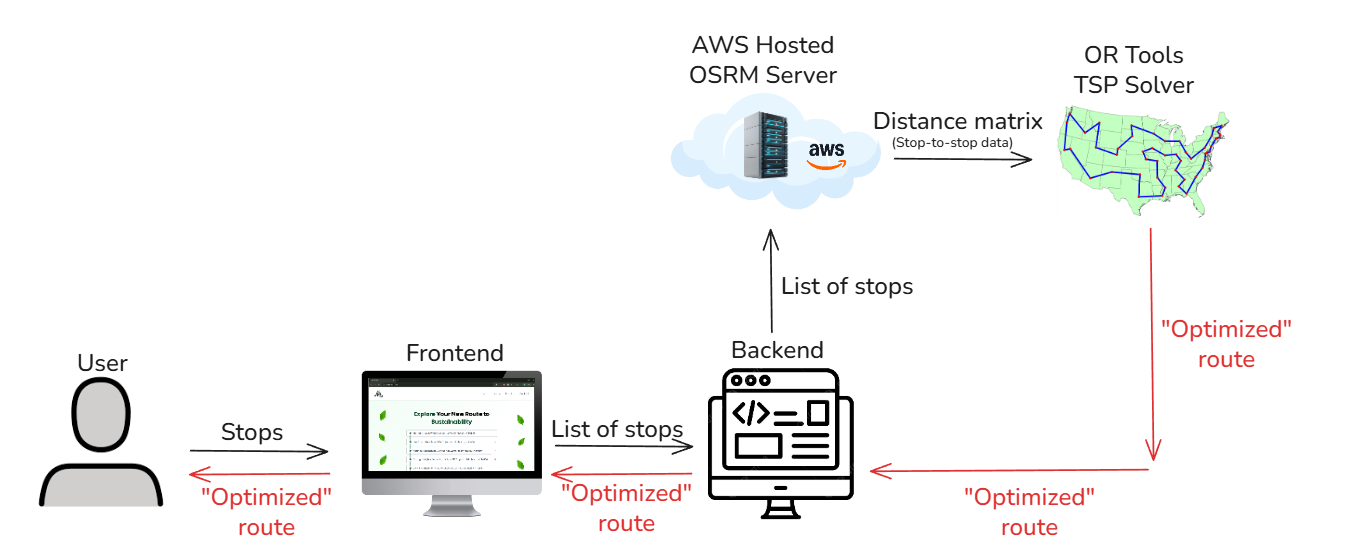
We're building a web-based routing tool that optimizes fuel consumption for transportation routes. While standard tools like Google Maps optimize point-to-point routing, pathOS optimizes the order of the stops and accounts for real-world factors like weight accumulation.
Every component is purpose-built for institutional users looking to cut carbon emissions and increase efficiency without impacting operations. Our goal is to reduce stakeholder emissions by 10%, saving thousands of tonnes of CO2 annually.
System Architecture
A modular, data-driven platform for emissions-optimized
routing using fundamental physics and metaheuristics
Simulated
Annealing
Utilizes Simulated Annealing to account
for weight accumulation, achieving
100% success on test routes
Fuel Consumption
Modeling
Predicts consumption using drag, grade,
and friction with an average error
of only 150 mL per trip

Open Source
Routing Machine
Powered by AWS "Wake on Demand"
architecture, slashing operating
costs by 90%